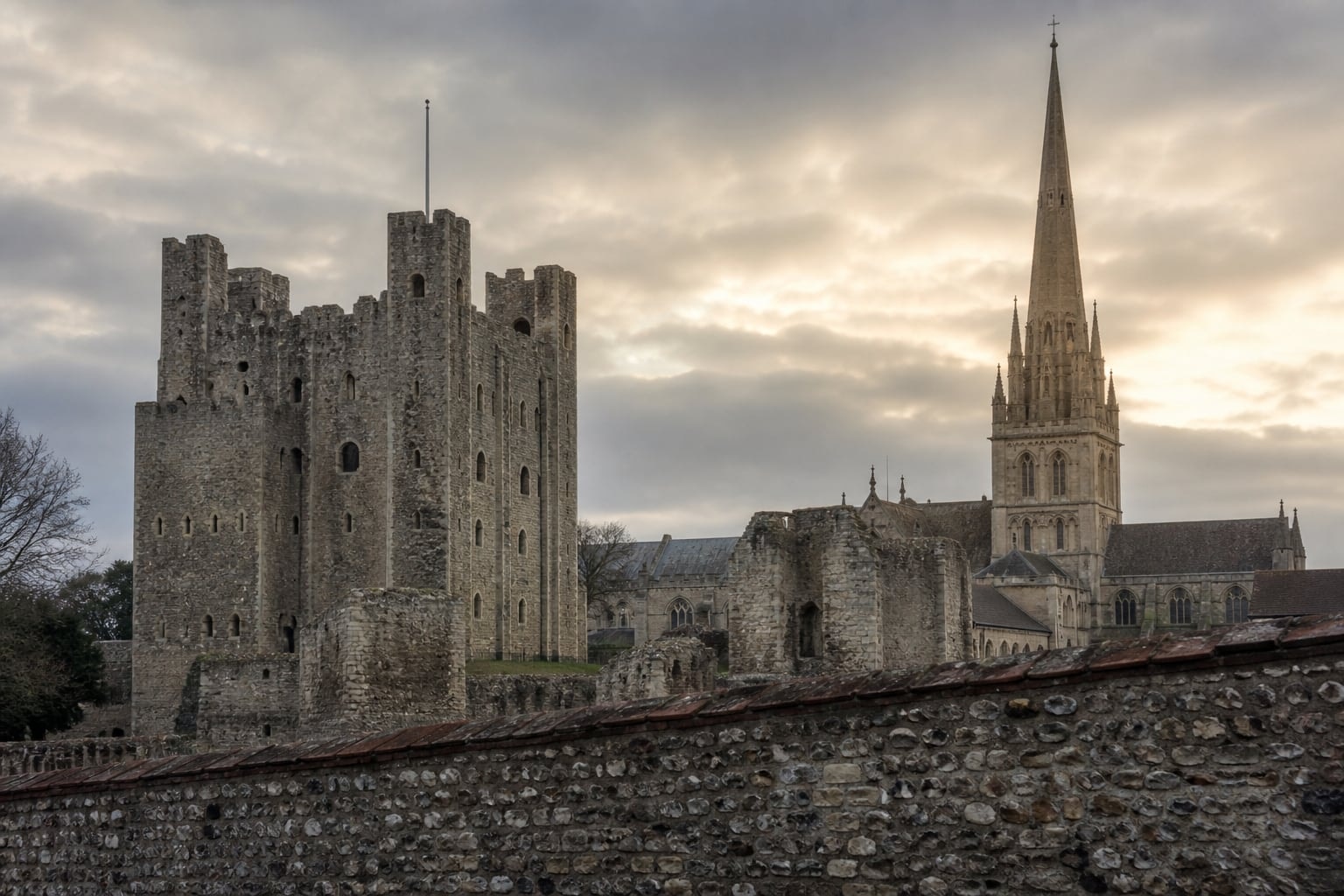
Reading cathedral and castle together
Few English city centres place two monumental medieval institutions in such immediate conversation. In Rochester, the cathedral precinct and castle occupy neighbouring ground above the Medway crossing. Their closeness can make a first visit feel self-explanatory—church beside fortress—but the better experience comes from slowing down and noticing how differently the two complexes handle space, movement and authority.
Begin outside the entrances
Before entering either site, walk the shared area and look at approach lines. The castle keep advertises height, mass and command of the crossing. The cathedral gathers attention through a more layered composition of west front, towers, adjoining precinct and later fabric. Move far enough away to see both in the same field of view, then come close enough to study material and repair.
The official monument record describes the castle’s tower keep, bailey, curtain wall and outer ditch, and places the complex at the Roman road crossing. It also records construction and rebuilding across multiple medieval periods. Reading the national heritage entry before or after a visit helps distinguish surviving elements from a generic idea of “a Norman castle”.
Notice thickness, light and sound
Fortified architecture makes thickness visible. Openings narrow, stairs turn, and the relationship between interior and exterior is controlled. Ecclesiastical architecture works with enclosure too, but it often directs attention through rhythm, height, filtered light and sound. Compare what each building asks your body to do: climb, pause, look up, cross a threshold, lower your voice or adjust to darkness.
These observations remain useful even when part of a site is closed. A visit need not depend on reaching every level. Exterior walls, changes in stone, the shape of the precinct and views across the city can still explain a great deal. Visitors with access concerns should check current official arrangements rather than assume that a medieval building offers a continuous route.
Treat restoration as history
Both ancient monuments and active religious buildings are maintained, repaired and interpreted. Fresh-looking stone is not automatically an error, and weathered stone is not automatically original. Repairs show changing conservation methods and the decisions required to keep complex structures in use or safe. Look for changes in tooling, mortar, joint lines and colour, while avoiding the temptation to assign a date without evidence.
An official archive image and summary of the cathedral’s architectural development notes rebuilding and later restoration. Use such sources as orientation, then follow current on-site interpretation for precise phases and features.
Build a humane visiting sequence
Do not schedule both sites as back-to-back endurance tests. One may involve climbing and exposed weather; the other may call for quiet attention and standing. Put a rest between them, especially if the day also includes the High Street. A simple sequence is exterior comparison, one interior visit, a pause, then the second site or riverside.
Remember that the cathedral is a living place of worship, not only a heritage attraction. Observe current visitor guidance, avoid interrupting services and keep photography considerate. The castle, though monumental, also sits within a contemporary city used by residents. Respect barriers, lawns, neighbouring streets and other people’s quiet experience.
End with the crossing
After studying both complexes, look back from a point where river, bridge and high ground can be connected. The placement becomes the final exhibit. Defence, worship and movement concentrated here because the crossing mattered. That geographic fact is the thread joining the day’s architectural details into a coherent story.
Carry context, not certainty
A pocket note with two or three verified facts is enough. Let current interpretation supply the detail and resist repeating an overheard claim as history. The strongest observations describe material, space and movement accurately, then leave dates and attribution to evidence.