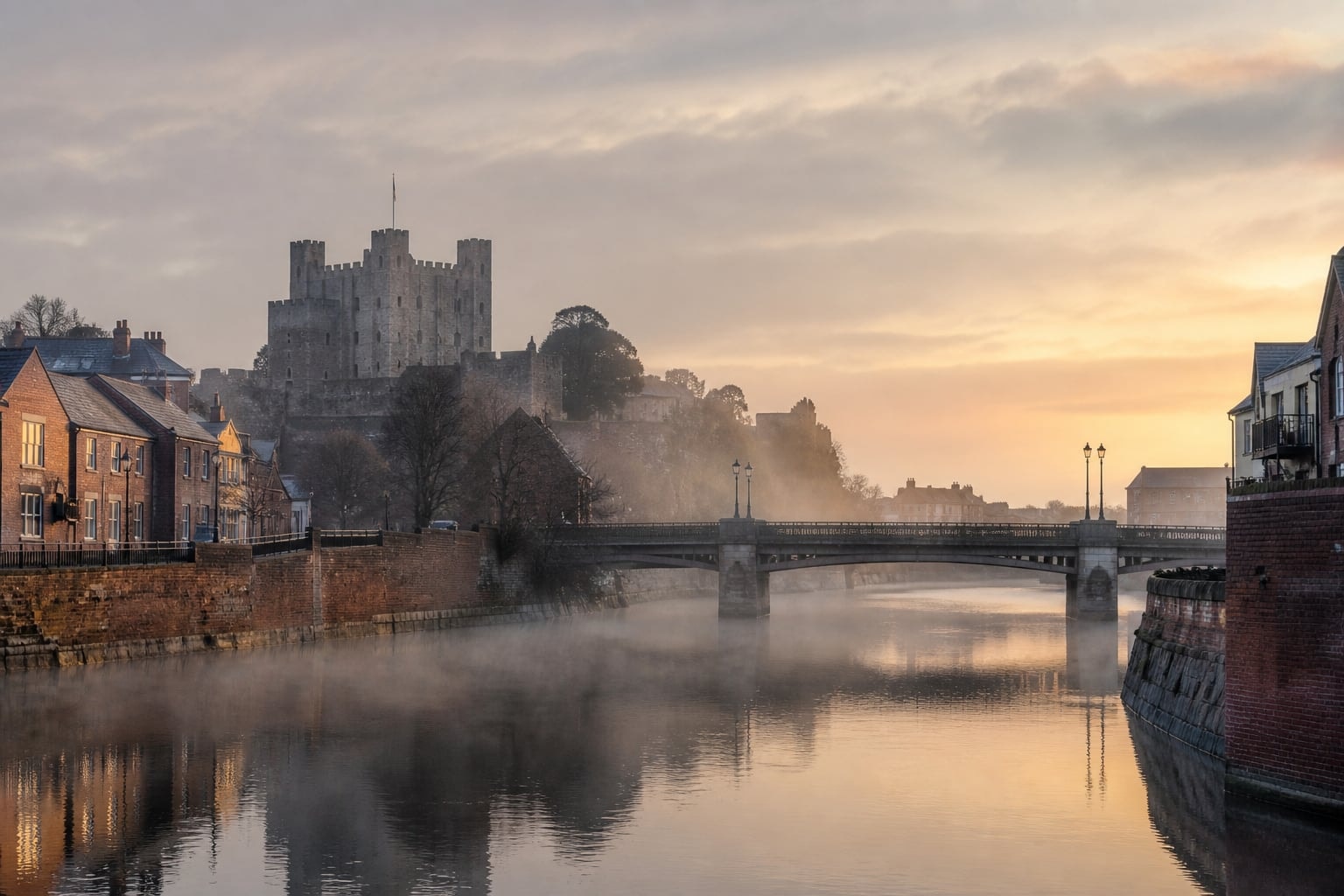
Reading the River Medway at Rochester
The river is Rochester’s organising fact. Roads converge because a crossing is possible; fortification occupies high ground because the crossing needs control; trade grows because water and road meet. From the bank, these historical relationships can be understood without turning the river into a backdrop.
Start with movement
Watch how people, trains, road traffic and boats cross or follow the water. Different systems occupy different levels and move at different speeds. The river has not stopped being infrastructure simply because a visitor pauses to admire it. Notice which routes point toward the High Street and which continue along the wider Medway towns.
The local visitor service describes a crossing at Rochester dating back to Roman times and outlines the later history of bridge maintenance in its account of the historic bridge chapel and crossing. Check current access and opening information at the source before including any interior in an itinerary.
Use the keep as a compass
The castle keep is visible from multiple riverside positions and makes the logic of the site clear. Rather than photographing it from only one celebrated angle, move a short distance and watch how bridge, wall, slope and skyline realign. The monument’s relationship to the crossing is more informative than a view that isolates it.
Weather changes the river quickly. Wind can be stronger on exposed sections than on the High Street; glare can flatten detail; mist can erase the far bank. Carry a layer and treat poor visibility as a different way of reading scale. Wet stone, moving cloud and reflected light are part of the place, not interruptions to an ideal photograph.
Plan an out-and-back, not a forced loop
A riverside route does not need to close a circle. An out-and-back walk allows a traveller to turn when energy, weather or light changes. The return direction produces different views, especially toward the historic centre. Decide on a time limit rather than a distant endpoint and keep enough margin for the walk back.
Surfaces and gradients vary. Anyone who depends on a step-free route should use current mapping and local access information, then confirm any critical link. Our accessible travel checklist explains why distance alone is a poor measure of a route.
Look for working edges
Rivers create awkward boundaries between public space, infrastructure, habitat and private land. Follow signs and barriers, avoid assuming every visible edge is accessible, and give wildlife room. Do not climb for a photograph or enter service areas. A responsible riverside walk pays attention to use as well as view.
Connect the river to the stay
An early or late riverside walk can frame an overnight visit, but it should not depend on unverified lighting, access or weather assumptions. Check sunset, conditions and the return route. If the day has involved stairs and stone floors, choose the gentler section and let the river be recovery rather than another task.
Back in the historic centre, the street plan feels less accidental. The river explains why movement narrows here; the monuments explain who once controlled and served that movement. This is why the history overview begins with a crossing rather than a date.
A small observation exercise
Stand safely away from the path edge and choose one fixed object—bridge pier, wall or tower. Watch the water and traffic move around it for five minutes. Note sound, direction and scale. That simple comparison turns the panorama into a set of relationships and gives the river its active role back.
Keep weather in the decision
River conditions can change faster than conditions between buildings. Check the forecast, carry an extra layer and turn back before discomfort becomes the main memory. In strong wind or heavy rain, an indoor history stop can preserve the same crossing theme without forcing an exposed route.