How to evaluate hotel services before a stay
The word “services” can cover almost anything, from a reliably staffed arrival process to a decorative tray in a photograph. A useful comparison begins by separating what affects the stay from what merely sounds pleasant. This page preserves a genuine legacy services URL, but its purpose is now independent and educational: it describes questions that can be asked of any current accommodation provider without making claims about a particular business.
Start with the moments that can fail
Think through the stay as a sequence: arrival, entry, sleep, washing, leaving belongings, breakfast or another first meal, and departure. At each stage, identify the one condition that would cause real difficulty if misunderstood. A late arrival needs a confirmed handover process. A traveller carrying heavy luggage needs to know about steps between the street and the room. Someone working the next morning needs a quiet place, power near the desk and a dependable connection rather than a general statement that internet access exists.
Write those essentials in plain language. “Step-free route from entrance to bedroom” is better than “accessible”. “Arrival possible after the staffed desk closes” is better than “late check-in”. Specific wording gives a provider something definite to confirm and gives the traveller a useful record.
Distinguish a facility from its conditions
A facility can exist without being available in the way you expect. Parking may be limited, off-site, height-restricted or first-come-first-served. Breakfast may operate only on certain days or may need advance notice. Luggage storage may be available only while reception is staffed. A lift may reach some floors but not a mezzanine or a final short flight. The important question is rarely “Do you have it?” It is “Can I use it at the time and in the way my itinerary requires?”
- Arrival: confirm the staffed window, the procedure outside it and any identification requirement.
- Room position: ask about stairs, lift reach, street-facing windows and nearby evening activity.
- Sleep: check bed arrangement, blackout provision, temperature control and likely noise sources.
- Bathroom: ask for layout details when shower access, grab rails or turning room matter.
- Departure: confirm checkout timing and whether luggage can be retained afterwards.
Use accessibility questions that can be answered
Access needs are individual. A broad label cannot tell a wheelchair user the door width, a visually impaired guest how routes are marked, or a light sleeper whether an alarm has a visual signal. Government travel guidance recommends stating needs clearly, checking routes to the main areas and seeking written confirmation. Its accommodation-planning guidance for disabled travellers is written for overseas trips, but its method—specific questions, written answers and double-checking arrangements—is useful for domestic stays too.
The accessible-stay worksheet develops this approach for a compact historic city, where old thresholds and sloping streets can be as relevant as the bedroom itself.
Read photographs cautiously
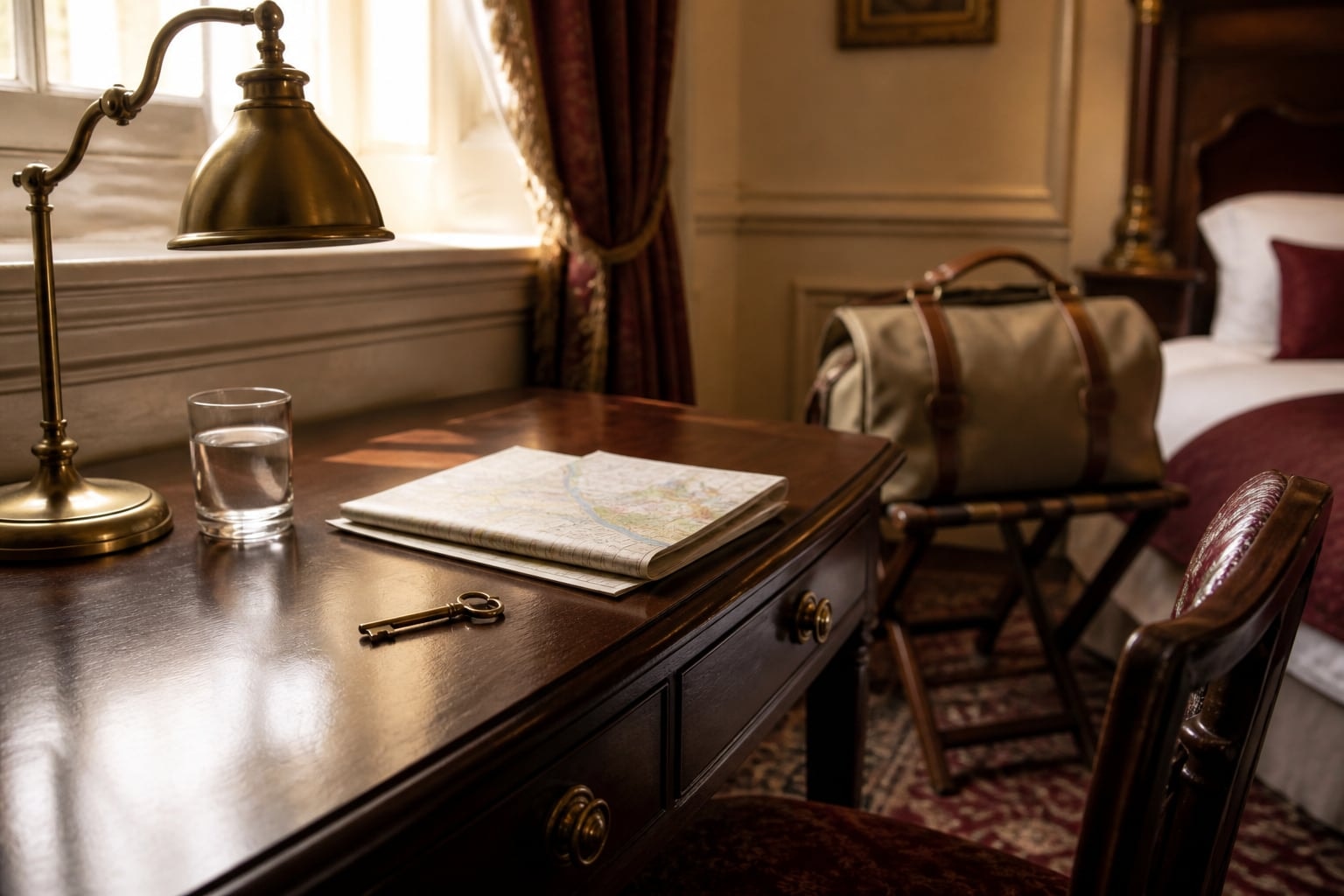
Photographs help with style and general proportions, but they are not specifications. Wide lenses make rooms appear larger. A picture may show only one room type, one staircase or a recently refreshed corner. Look for a complete sequence: exterior threshold, entrance, shared route, bedroom, bathroom and any facility you plan to use. If an essential part of that sequence is missing, ask for a description instead of filling the gap with an assumption.
Keep the confirmation short
Once the answers are gathered, reduce them to a one-page stay note: arrival method, room arrangement, access facts, meal plan, parking or rail plan, and the current cancellation terms supplied by the provider. Save the current provider page or confirmation with the date. Policies change; a concise record is more useful than memory.
Good service research is not about demanding every possible amenity. It is about matching a few actual needs to precise, current information. That produces a calmer arrival and leaves more attention for the city outside.